Secrets
Secrets — API keys, tokens, alternate-endpoint credentials — must never live in .claude/settings.json, because that file is committed to the repo. worca keeps them in a separate, gitignored file.
Where secrets enter the system
Section titled “Where secrets enter the system”You don’t hand-edit a secrets file. Two UI surfaces write secrets to .claude/settings.local.json for you:
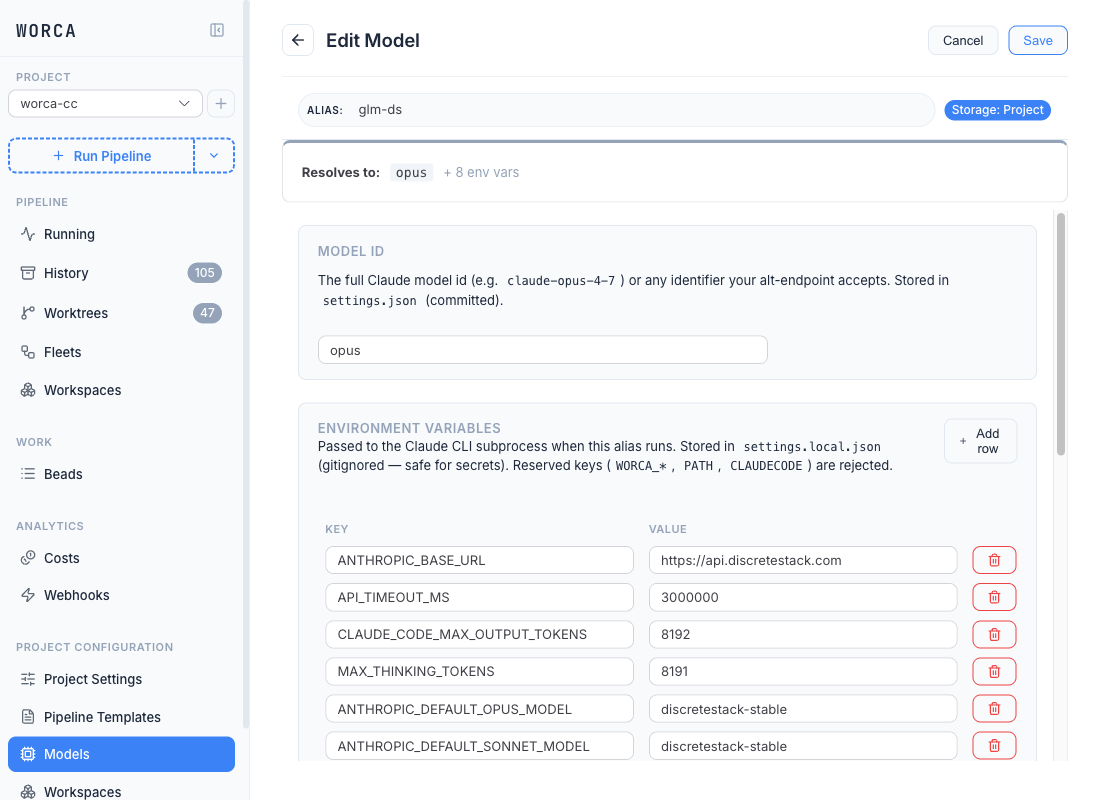
- Model Editor (Models page) — the Environment variables table on each model card writes its values to
settings.local.json. Theidfield above it writes tosettings.json. The id/env file split is enforced by the editor, soANTHROPIC_AUTH_TOKENfor an alt-endpoint alias goes to the gitignored side automatically. - Settings → Secrets (global Settings) — a free-form key/value editor for variables that aren’t per-model (e.g.
GITHUB_TOKENfor the guardian’s PR creation).
Both write to the same .claude/settings.local.json file, which is gitignored (added automatically by worca init) and deep-merged over settings.json at runtime.
Reserved keys
Section titled “Reserved keys”A handful of environment keys are managed by worca and can’t be set as secrets — anything matching WORCA_*, PATH, or CLAUDECODE is silently stripped with a warning. This prevents a secret from clobbering the variables the pipeline relies on.
Secrets in worktrees
Section titled “Secrets in worktrees”Each run executes in an isolated git worktree. The parent project’s settings.json and settings.local.json are read by worca init --worktree-propagation; secrets from the parent are then materialized into the worktree’s own gitignored settings.json so agents can use them — the same on-disk plaintext exposure model as ~/.aws/credentials. They’re never committed.
Sharing config without sharing secrets
Section titled “Sharing config without sharing secrets”When you export a template bundle (worca templates export), the export reads settings.json for structure and settings.local.json only to splice the alias env blocks back into the bundle’s models.json member — and that splice runs through two passes of redaction before anything is written. A structural allowlist controls which config subtrees can leave the machine; a per-value scan replaces known-secret-format values (Anthropic, GitHub, Slack, AWS prefixes) with the placeholder <YOUR-SECRET-HERE> while keeping the env-var keys intact.
On import, an alias whose env contains <YOUR-SECRET-HERE> shows a danger Not configured badge on the Models page card and a red-bordered value cell in the editor. Save stays enabled — the badge is the discoverability signal that the recipient still needs to fill the placeholder in locally.
See Share via export/import bundles for the full mechanics, including the trust-boundary caveats around HTTPS sources.